Experimental memory ledger
The v0.10 ledger turns a durable memory from an unstructured vector chunk into
a scope-pinned record with an explicit lifecycle, immutable ingress provenance,
and a host-owned admission decision. It is deliberately opt-in and
experimental: it does not change MemoryService, profiles, session
compression, vector recall, or ContextPlan until a host explicitly installs
an adapter. In v0.11 that adapter can be the narrow experimental
LedgerContextComposer for admitted Ledger recall; it does not enable Ledger
globally or change legacy paths. v0.12 schema v6 adds an optional sealed
recall-checkpoint manifest for that explicit lane; it still does not serialize
agent state or wire Ledger into an application automatically.
Schema v7 adds a host-only, exact-scope canonical payload-purge receipt; see exact-scope payload purge for its deliberate limits and required application-side deletion fence.
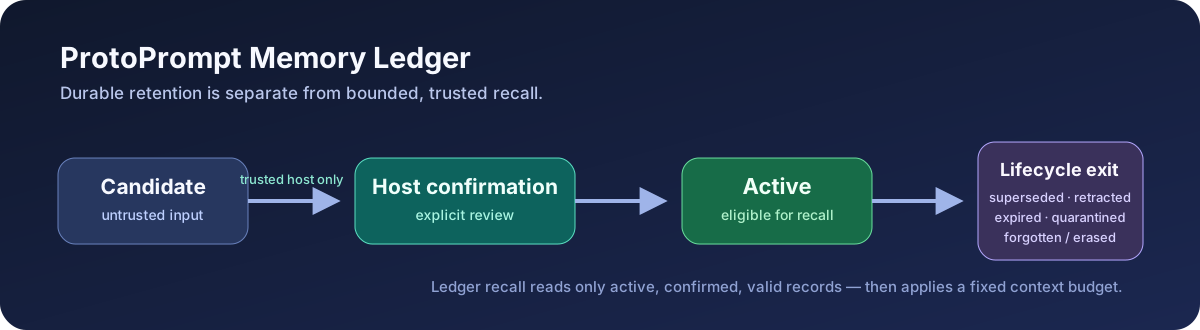
That separation is intentional. A PDF, tool result, transcript, or model extraction must never become a trusted system-priority fact simply because it was persisted.
Quick start
Schema setup is an operator action, never an import-time side effect:
from protoprompt.ledger import (
    MemoryAdmissionAction,
    MemoryAdmissionPolicy,
    MemoryKind,
    MemoryOrigin,
    MemoryReviewGate,
    MemoryWriter,
    SqliteMemoryLedger,
)
from protoprompt.scope import MemoryScope

ledger = SqliteMemoryLedger("memory-ledger.db")
print(ledger.dry_run_setup())  # no writes
ledger.setup()                 # explicit, idempotent ledger schema setup

writer = MemoryWriter(
    ledger,
    scope=MemoryScope(tenant="local", user="alice", thread="chat-42"),
)

# The host fixes authority-bearing ingress fields before untrusted text
# arrives. MemoryAdmissionPolicy() by itself quarantines every origin.
policy = MemoryAdmissionPolicy(
    policy_id="local-document-v1",
    policy_version="1",
    allowed_origins=(MemoryOrigin.DOCUMENT,),
    minimum_confidence=0.8,
)
gate = MemoryReviewGate(writer, origin=MemoryOrigin.DOCUMENT, policy=policy)
document_ingress = gate.ingress(
    kind=MemoryKind.PREFERENCE,
    source_ref="turn:42",          # host-minted opaque ID, not raw text
    evidence_refs=("turn:42:line:1",),
    confidence=0.9,
)
candidate = document_ingress.submit("The user prefers answers in Russian.")

# review() is pure; a sealed result is applied explicitly by trusted host code.
review = gate.review(candidate.record_id)
assert review.action is MemoryAdmissionAction.ALLOW
active = gate.confirm(review, event_id="admission:turn-42:allow")

assert writer.list_active() == [active]
MemoryWriter is constructed with one non-empty, host-owned MemoryScope.
Its mutation methods do not take a tenant, user, thread, lifecycle state, or
trust level. The lower-level SqliteMemoryLedger requires that same exact
scope on every operation. This is an API-shaping guard inside a trusted host
process, not a Python sandbox or authorization boundary: do not expose either
object to untrusted code.
PostgreSQL deployment (experimental)
PostgresMemoryLedger exposes the same trusted synchronous Ledger command
surface as SqliteMemoryLedger, but it is a separately provisioned backend.
Install protoprompt[postgres], run its explicit dry_run_setup() and
setup() from a migration job, and assign it an otherwise empty dedicated
PostgreSQL schema. It accepts fresh schema v7 only: it does not migrate an old
PostgreSQL Ledger or import a SQLite Ledger file.
Each write in that schema takes a transaction-scoped advisory lock so that
lifecycle, admission, strict recall, and checkpoint validation retain their
exact semantics under PostgreSQL MVCC. This deliberately serializes writes;
the host must handle LedgerConflictError by retrying an idempotent whole
command with its stable event_id, not by rerunning a SQL fragment. The
adapter is synchronous and therefore needs a worker/thread boundary in an
async application. Use the database platform's backup policy or pg_dump —
its backup() method intentionally does not implement a file-copy backup.
The PostgreSQL and pgvector guide contains the required schema,
privilege, backup, restore, retention, and capacity guidance. forget() or
erase() affects live Ledger rows only; it cannot erase prior WAL, replicas,
backups, or external projections by itself.
Admission boundary (v0.10)
MemoryReviewGate has one fixed scope, origin, policy, and actor. Its
ingress() creates a narrow host-configured endpoint: submit(content) is
the only variable input. The caller cannot choose scope, origin, kind,
confidence, source/evidence identifiers, lifecycle state, record ID, or event
ID. The closed origins are user_input, document, tool_output,
model_extraction, and host_assertion; unknown and legacy_unknown are
not reviewable origins.
review() does not write. It produces a sealed in-process MemoryReview;
only the creating gate can apply it. Its action maps exactly to one lifecycle
result: allow → active, quarantine → quarantined, and reject →
forget() with the payload removed. Every applied gate decision writes one
content-free MemoryAdmissionAudit paired with its lifecycle event. A
concrete-origin record cannot become recallable through MemoryWriter.confirm;
the raw confirmation API rejects it unless its origin is unknown or
legacy_unknown.
This is an API boundary inside a trusted host process, not a Python sandbox.
The model must receive a JSON/RPC tool schema with exactly { "content":
"..." }; the host adapter derives scope, origin, source, policy, and action
outside the model. Never pass a MemoryReviewGate, MemoryWriter,
SqliteMemoryLedger, MemoryReview, or ingress object to arbitrary in-process
plugin code. If arbitrary plugins execute in the same process, isolate this
adapter behind a process/RPC boundary first.
The legacy raw writer remains a trusted-host compatibility and cleanup escape
hatch. writer.propose() / writer.assert_candidate() create unknown
provenance, and raw lifecycle cleanup does not create an admission audit.
Use it only for existing trusted integrations; it is not a model tool and is
not a strict-admission path.
Lifecycle and recall
| State | How it gets there | Default recall |
|---|---|---|
candidate |
gate ingress, or legacy trusted raw writer | never |
active |
sealed gate allow, or legacy raw confirmation |
only while valid and payload-present |
superseded |
explicit supersede(old, replacement) |
never |
retracted |
retract() or forget() |
never |
expired |
expire() / expire_due() |
never |
quarantined |
sealed gate quarantine() or trusted cleanup |
never |
Every lifecycle transition takes expected_revision; stale commands fail
instead of silently overwriting a newer decision. forget() records a
forgotten event and advances the revision even when a record was already
retracted, so payload removal invalidates stale cached projections while the
original retracted_at remains the time it first left recall.
A caller may retain an event_id across a retry. It is idempotent while the
original command remains addressable; a completed forget() retry returns its
stored erasure receipt. Replaying a candidate after its payload was forgotten,
or any command after a hard erase, is deliberately rejected rather than
resurrecting data. Reusing an ID for different input always raises a conflict.
For a concrete v5 origin, list_active() validates the matching immutable
allow audit, event payload, origin, revision, and reason before exposing a
record to recall. A malformed or missing audit fails closed. SQLite is still
not tamper-evident: a party that can directly alter the database, disable
triggers, and forge a self-consistent event can defeat an in-database audit.
Protect the database file and use an external signing/key-management boundary
when that threat is in scope.
Replacing a fact is explicit and deterministic:
# ``new_active`` was admitted by its matching MemoryReviewGate above.
new = new_active
old = writer.supersede(
    old_active.record_id,
    replacement_record_id=new.record_id,
    expected_revision=old_active.revision,
    expected_replacement_revision=new.revision,
)
The replacement receives a typed supersedes relation in the same scope. No
cross-scope relation or implicit “latest wins” heuristic exists.
Retention and deletion
The operational event history contains no plaintext memory, source ID, evidence ID, or content fingerprint. Plaintext and opaque provenance live in a separate local payload row; v4 setup explicitly scrubs the legacy creation fingerprints written by earlier experimental schemas.
retract()immediately excludes a record from recall but keeps that local payload for review.forget()moves it toretracted, deletes its local plaintext, source/evidence payload, source lookup entries, and relations, and redacts its stored content fingerprint. A content-freeforgottenevent and lifecycle receipt remain. It intentionally retains any content-free v5 origin metadata and admission audit so a rejected decision can be audited.forget_by_source("pdf:opaque-id")is atomic for all currently linked records in the writer's exact scope. It also keeps a scoped opaque source tombstone, so that source cannot be ingested again in that scope; the same source ID remains independent in another scope.erase()is the explicit irreversible local escape hatch: it removes the record, payload, relations, v5 provenance/audits, and its event receipts. It also redacts links to that record from events owned by other records. It retains scoped opaque replay tombstones and its hard-erase receipt so an in-flight retry cannot resurrect the erased record ID; use a fresh record ID for a new memory.
This first slice has no external vector/FTS projection adapter. Therefore it
does not claim that forget() or erase() remove data from a separate vector
database; an adapter must provide durable deletion acknowledgement before
exposing that guarantee. Both operations affect live ledger rows, while SQLite
cannot promise erasure from historical backups, WAL/journal files, or physical
media. Use encryption/key destruction and a documented backup-retention policy
when that property matters.
Safety boundaries
- Content is bounded to 16,000 characters; opaque IDs and references are bounded and cannot contain whitespace or raw multi-line text.
source_refandevidence_refsare host-minted provenance IDs. Do not put a filename, URL with secrets, prompt, or document body in them.content_hashis a scope-separated operational fingerprint, not a cryptographic audit or password primitive. It is redacted afterforget(). The SQLite event log is not tamper-evident.export()excludes plaintext by default; useinclude_content=Trueonly in an explicit, protected export flow.
Migration and rollback
Use a dedicated ledger SQLite file by default. A ledger can share a file with
the tested legacy SqliteStore because it never imports chunks, profiles, or
session summaries automatically. Its table, explicit-index, and event-trigger
names are reserved rather than globally namespaced. There are no schema
extension points: dry_run_setup() and setup() accept only the exact
ledger-owned table/index definitions and reject external indexes or triggers
that target ledger tables, instead of adopting, overwriting, or silently
running them.
- Run
dry_run_setup()and back up the database withledger.backup(path). - Call
setup()in an explicit migration job. v5 backfills only payload-bearing pre-v5 records aslegacy_unknown; it never invents a modern origin or review audit. Pre-v5 active records remain recallable for compatibility. Schema v6 adds sealed recall-checkpoint manifests and their private selection sidecars; schema v7 adds durable exact-scope payload-purge receipts. Neither migration backfills a checkpoint or invents a deletion request from an old plan. - A strict deployment must inventory those legacy active records, quarantine them through trusted lifecycle code, and re-ingest/review the data through a concrete v5 origin before enabling recall. Do not claim that a migrated legacy record passed v0.10 admission.
- Keep legacy readers authoritative while evaluating a separate opt-in adapter or importer.
- Roll back application traffic only by restoring a pre-upgrade backup into a separate database and returning traffic to the old components. Older code rejects newer schemas, including v7, so do not attempt an in-place or destructive downgrade of a shared database.
Both dry_run_setup() and setup() validate the schema-v6 checkpoint sidecars
and schema-v7 durable-receipt layout. They cannot authenticate a manifest HMAC because
the stable checkpoint_secret deliberately remains outside SQLite; a strict
LedgerRecallPlanner.resume_checkpoint() holding that host secret performs
the authenticity check.
Restart recovery
MemoryReview is deliberately process-local: after a restart a new gate
cannot replay a prior sealed review. Before applying an action, retain the
candidate record_id returned by submit() and your host-minted action
event_id. On recovery, use writer.events(record_id) and
writer.admission_audits(record_id):
- a matching admission audit/event means the decision is final; do not re-review it;
- a concrete-origin admission lifecycle event without its matching audit is a corruption/atomicity alarm; stop;
- neither admission event nor audit while the concrete-origin record is still a candidate requires a new sealed review. A hard-erased record and its prior event IDs are terminal and must never be recreated.
A v6 recall checkpoint is separate from MemoryReview: resume it only through
a fresh strict LedgerRecallPlanner with the same protected
checkpoint_secret, compatible policy/fingerprint and counter_id, and a
fresh task. The manifest contains only opaque continuation identity and
selection metadata, never task text, plaintext memory, or provider messages.
Changing the lifecycle of a selected record invalidates that checkpoint and
removes its selection markers; it is not an agent/workflow recovery system.
Profile/session/vector importers and bridges for facts/episodes/procedures/RAG
evidence remain future work. The experimental LedgerContextComposer covers
only the narrow admitted Ledger JSON → one bounded request path, including an
explicit sealed-checkpoint resume when the host invokes it. There is no lease,
exactly-once delivery, workflow engine, or automatic integration; the ledger
and its recall lane preserve all other public behavior until migration contracts
are separately proven.